
The Palestinian Institute
for Climate Strategy
for Climate Strategy
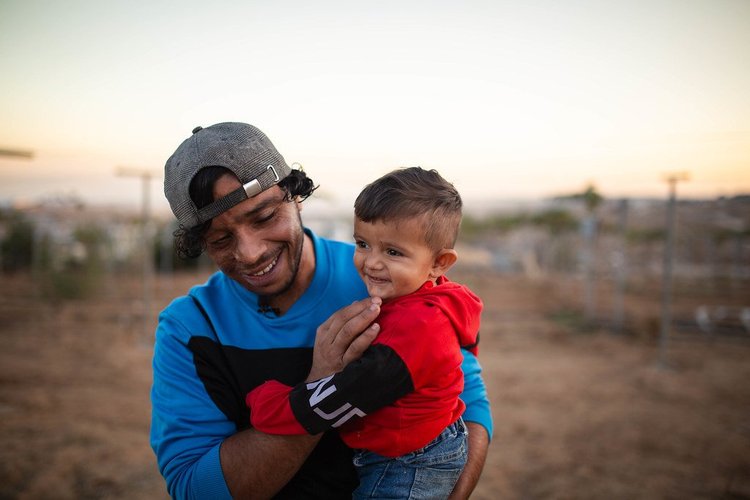
On July 28, 2025, he was shot dead in broad daylight by a settler – who was operating a bulldozer, destroying olive trees and water pipes – while documenting the destruction of Umm al‑Khair. The news of his murder sent shockwaves across Palestine and the world. His family and neighbors are grieving, but so are the many people who have met him as a teacher, activist, or guide.
I first contacted Awdah last year during demolitions in Umm al-Khair. A mutual friend gave me his number as I was writing an article for Al-Jazeera on ecocide. He responded quickly, offering to talk at any time that suited me. Later he sent another message: “صدقني الوضع صعب” – “believe me, the situation is difficult.” That was our only exchange. Exactly one year later he was killed.
A week after his death I received another message from his number. This time it was his family, reaching out through the same line. They wrote: “We want to stay connected and continue the important projects in the community… the work that Awdah was doing with all of our friends around the world.” They asked the world to support his brother Khalil, now head of the Umm al-Khair council, and to stand with Hanadi, his wife, who continues to run the village guesthouse.
Awdah studied English at Hebron University and came back to teach in his village. For him, education was a way to help children speak to the world. He welcomed visitors to Umm al-Khair, insisting they stay for tea or a meal. In a village under siege, hosting outsiders turned them into witnesses.
He worked on the Oscar-winning documentary No Other Land and trained young people to document demolitions. When soldiers cut the electricity mid‑workshop, he said: ‘This is what lights are for. We will continue with the lesson. For him, storytelling was a defense against erasure, to preserve memory.
Before his killing, Awdan sent one final broadcast message. It was a direct call to action. Settlers had begun trenching near the houses and threatening the main water pipe. He wrote: “If they cut the pipe the community here will literally be without any drop of water. If you can reach people like the Congress, courts, whatever, please do everything.” Even in his final hours, his focus was on water and the survival of his community.
Israeli authorities refused to release Awdah’s body to his family. To pour salt on the wound they ordered a night-time burial outside of the village with only a few mourners allowed to attend. Awdah’s family refused. In response, more than sixty women of Umm al-Khair, including his wife, mother, and sisters, went on a hunger strike. They declared they would not eat until his body was returned, until those arrested during the settler attack were freed, and until his killer was prosecuted. Some collapsed and were taken to hospital, but the strike continued. Their action carried forward Awdah’s own refusal to surrender dignity.
Awdah’s life showed what decolonization meant in daily life: teaching children under demolition orders, welcoming outsiders to bear witness, documenting injustice with a phone, defending water as life. His murder was a clear attempt to silence that vision. And yet his family’s message to the world and his community’s persistence in the face of adversity make clear that the vision will not be erased.
What makes this moment an even greater tragedy is the recognition of loss in Gaza and the West Bank. It is the same system of apartheid and genocide that seeks to erase us both. Yet, we continue, and we come back with even more strength and determination to live on in the memory of those who have passed. As a Palestinian from Gaza, I see the same system of violence, the one now ravaging Gaza, at work in the West Bank. Our families share the same history and pain, and yet resistance connects us across Israel’s violent apartheid walls. A brutal reality that does not require metaphors to capture.
For PICS, Awdah’s legacy matters greatly to our work. He linked land and water with survival and resisting oppression - the same link we highlight in our campaigns for ecological justice and liberation. That was his form of resistance, and it is ours as Palestinians and people standing in solidarity across the world to bring the truth to light. His family has asked that his projects continue, that visitors keep coming, that his words be shared. To honor him is not only to mourn but to act on his family’s request.
I did not know Awdah well, but even the short exchange we had last August told me something about how he lived: pressed on every side, yet still answering. His family’s message makes clear what they want to continue. His life remains a reference for the vision many were killed for: a Palestine where the land is cared for, families live without fear, strangers are welcomed, and water continues to flow, as life in Palestine has and always will on this land.
Hello dear friends of Awdah,
It is maybe strange to get a message from Awdah’s number.
We are writing to you as the family of Awdah and community of Umm al-Khair. First we want to thank you all for the support and solidarity in these weeks since our beloved Awdah was murdered.
We don’t know what to say – there is too much. But it is very important to all of us that we continue the important work that Awdah was doing with all of our friends around the world. We want to stay connected and continue the important projects in the community.
We also have a fundraiser for Awdah’s family and the community here.
The guest house is still open, and we are ready to welcome visitors, and as Awdah would say – you are welcome anytime.
You can read Awdah’s writing, as well as read and share stories and memories of Awdah here.
You can continue to share Awdah’s words on Instagram (@storiesof_uak) and Facebook (Umm Al-Khair Stories).
Thank you again,
From Awdah’s family in Umm al-Khair

.svg)
